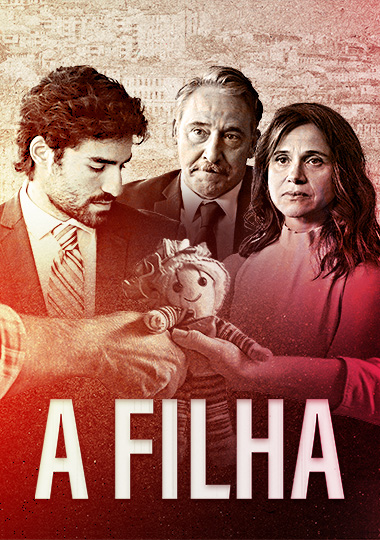
SYNOPSIS
This is the story of the umbilical cord: what can happen between parents and children, which lines of blood or love are sewn in family relationships, how do emotions and memory affect our choices in life.
In this proposal, the word growing is essential. Using as a reference Boyhood, by Richard Linklater, who, for more than ten years, filmed the same actor between his 6 and 18 years old, Filha intends to recreate, in 10 episodes, 3 different temporal realities, with three different actresses for the same role (newborn baby and up to 2 years old, girls aged 5 and 12). Each one of them will represent different stages in Renata’s (later nicknamed Maria Júlia) life and development. A girl with two names, two fathers and two mothers – the biological one not withstanding – each one of them assuming to be the only one.
In our present reality divorce and shared custody are normal. With this in mind, we would like to explore the undeniable difficulties for adults in reaching a mutual understanding on issues of shared parenting. The story deals with the theme of identity and how this may be influenced by the accompanying human landscape. What are the after-effects of these circumstances on one child’s personality? How will she face this whole story, once she understands it?
Renata/Maria Júlia, Heloísa and Paulo’s daughter, raised by Cristina and José, represents identifiable fears. There is the fear of knowing we have been abandoned by those who brought us into the world. There is the pressure we are under from those who are supposed to love us the most, birth parents and adoptive parents. Above all, there is the terrible obligation of choice. A choice that, in this case, should not exist. This story is a possible narrative of conscious human beings who theoretically know the difference between the good that can be done to a child and the evil, between what is right and what should never be attempted. No child should have to witness what Maria Julia witnessed: the conflict between her biological and adoptive parents. She should never have to choose between two families.
This idea was inspired by the real case of “Esmeralda”, a child born to a poor mother and given to a family to be raised. Shortly after, the biological father claims his daughter, entering a media and judicial battle that has divided the country. The judicial battle will be presented here in a simple way without being simplistic, since the approach used in court to deal with the case is one of the most peculiar points in the whole story. We all remember the case of Esmeralda. As a fact it surpasses all boundaries of common sense. And also as the fact that it was, it impresses.
Maria Júlia moves us. The story is hers, but each of the intervening parties has their own point of view, their own reason and their own understanding of reality. From Heloísa to Cristina, from Paulo to José we manage to understand each one of them, not demonizing anyone. The camera’s points of view will change according to the character we follow. We will look at the child’s connection to Heloísa, that umbilical love that doesn’t break but stretches; the connection to Paulo, who, despite not knowing her, fights for her as soon as he discovers that she is his biological daughter. We will address the relationship with Cristina, the mother who cannot have children. Cristina asks José to help her make a dream come true, and he himself starts to love Maria Júlia as if she were his own.
Everyone wants Maria Julia. Whatever the choice, the child is the target of a power struggle, and that power is the desire to love. It is appalling to place a responsibility of this magnitude on the shoulders of a human being still in formation. Maria Júlia was forced to grow up too early. Added to this we have the media coverage of the case and too many opinions issued either in favour of some or in favour of others. Heloísa is criticized for giving the child away and then giving up the fight; Cristina is criticized for her capriciousness and obsession; Paulo for his initial rejection; José for his irrational stubbornness. Throughout the narrative a sober dramaturgy prevails, sometimes almost formal, so that the spectator can be, at the same time, inside the characters and outside them, being able to feel what they feel, understanding, at each action performed, the difference between right and wrong.
Everyone talks a lot but few think about the only thing that matters: the well-being of Maria Júlia. Should the child stay with the adoptive parents or choose the biological father?
Cristina and José want to give Maria Júlia the opportunity of a future: they want to protect, to educate and accompany her growth. Heloísa wants the best for her daughter and Paulo claims what he believes is rightfully his. Paulo feels that Maria Júlia is his; Cristina and José seek recognition of their own love. The biological father’s reasons for wanting Maria Júlia are as legitimate as the reasons given by the adoptive parents. Or as illegitimate, if we consider that the adoptive parents take their daughter as a way to fill their affective need. As for the biological father the daughter becomes his life goal, the only one he has.
This is also the story of the unbreakable force of the will. Another reference in this story will be the film “A Separation”, by Asghar Farhadi, in which we witness the devastating consequences of the end of a family. Here, as there, everyone is ready to do anything because they know nobody will get a second chance. The tension is permanent and the intensity of the actions corresponds to the intensity of the feelings. In the end, the life of Cristina, Paulo and José are in Maria Júlia’s hands, just as Heloísa’s life ends at her hands. Maria Julia, who after all is only a child and never choose what happened to her.
AVAILABLE AS: Readymade and Format
AWARDS: